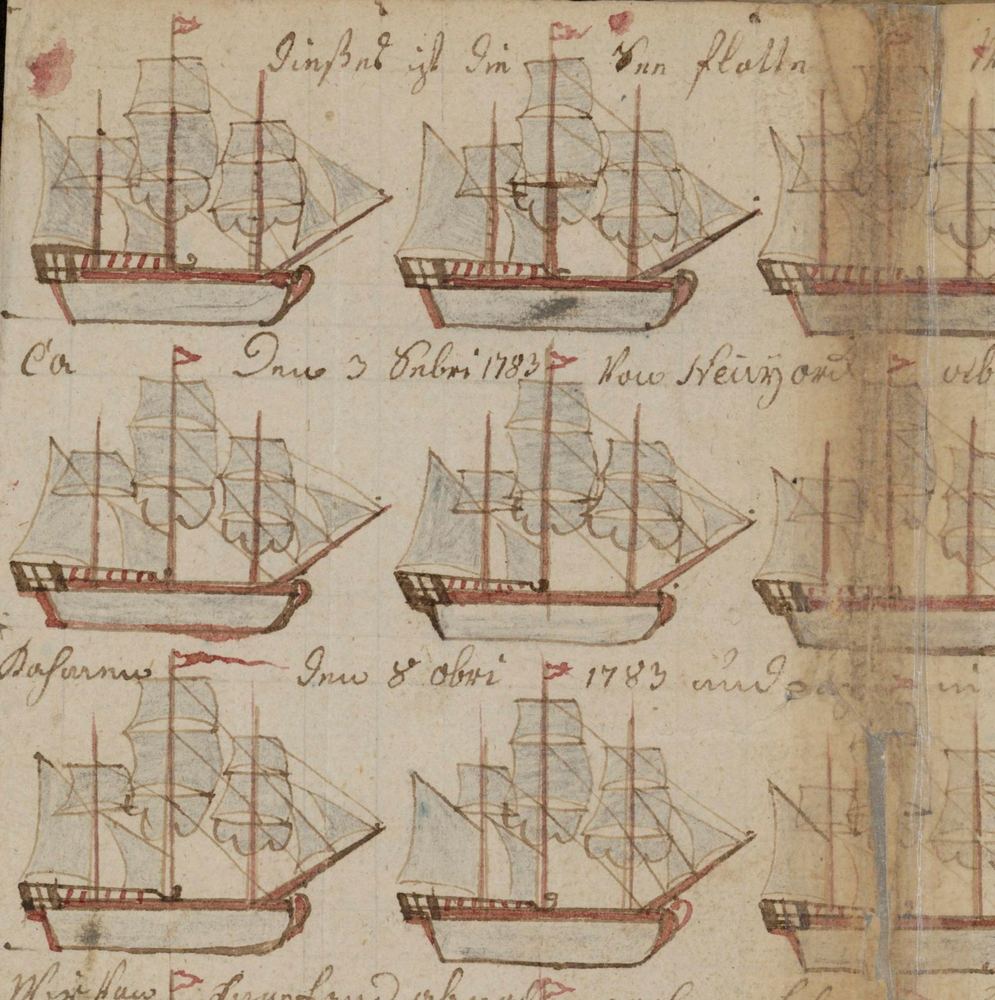
Reuber’s Diary
Johannes Reuber, a grenadier from Niedervellmar, wrote down what he lived through and drew what he saw: ships, camps, towns, and fortresses, from the Weser to Flanders.
At seventeen he went to America with Rall’s grenadiers in 1776. His diary is one of the few left by a common soldier of the Hessian troops. Today it is in Kassel, and anyone can view it free of charge.
How Reuber writes: the way he heard the names.
F. Washen Dau
for Fort WashingtonDrindaun
for TrentonSchärlles Daun
for CharlestonCopplentz
for Koblenz
Readings from the manuscript, some uncertain.
A diary you can open
Kassel University Library has put Reuber’s diary online. Every page can be enlarged there, line by line, drawing by drawing.
A complete edition of Reuber’s diary is in preparation. To be notified, write to info@cbb-verlag.de.
From the Weser to Flanders
Twelve of his drawings also appear in the book. Here you can see each one enlarged, next to the whole diary page. Click to open.
Fort Washington
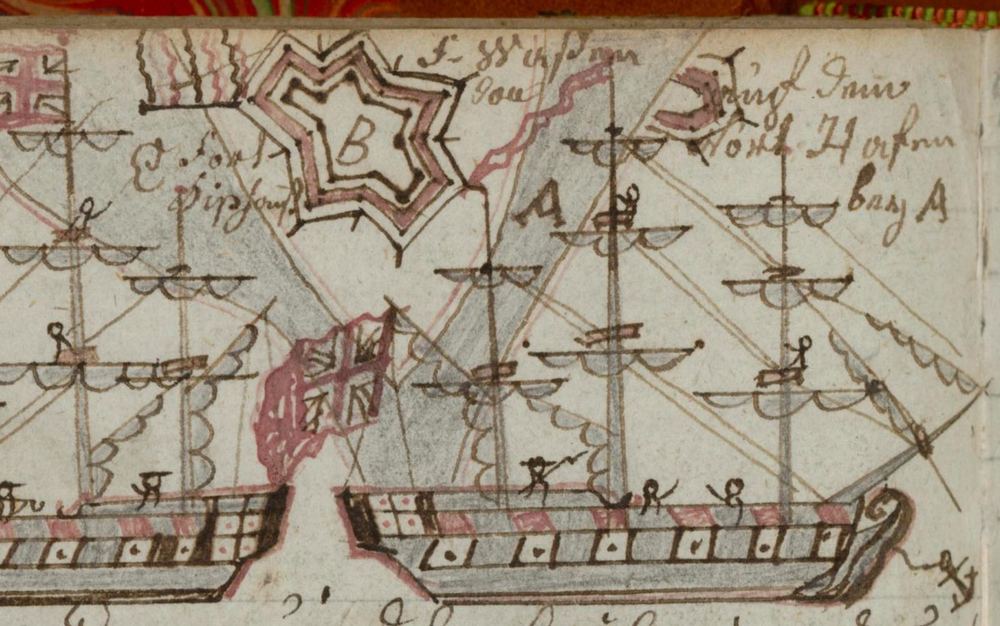
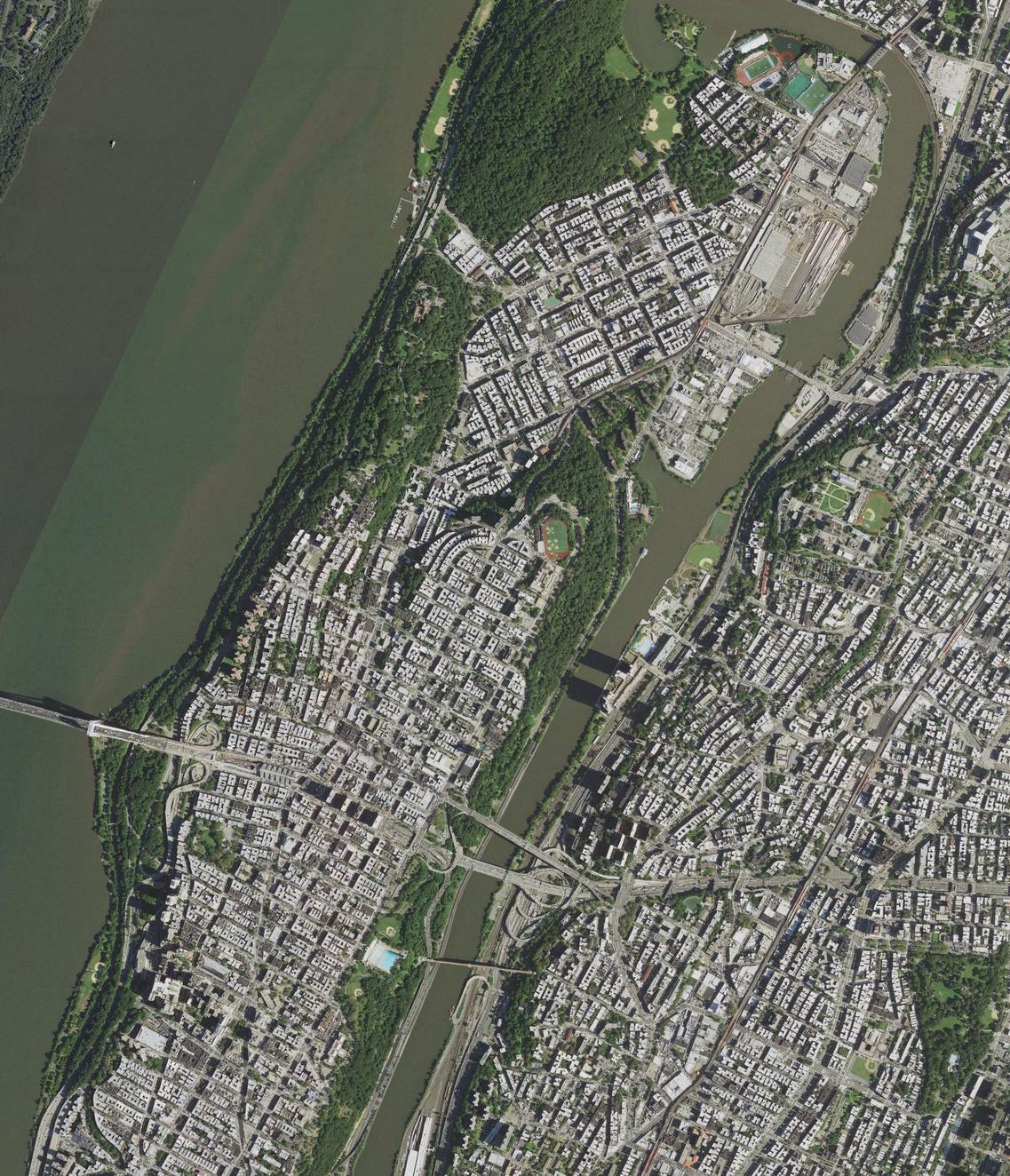
On November 16, 1776, British and Hessian troops stormed Fort Washington in northern Manhattan. Reuber was there with Rall’s grenadiers. He drew the fortress as a star between two rivers, with two British warships below it. How close is that to what others recorded at the time?
What happened that day and what Reuber wrote about it is on the page 250 Years Ago.

- What matches
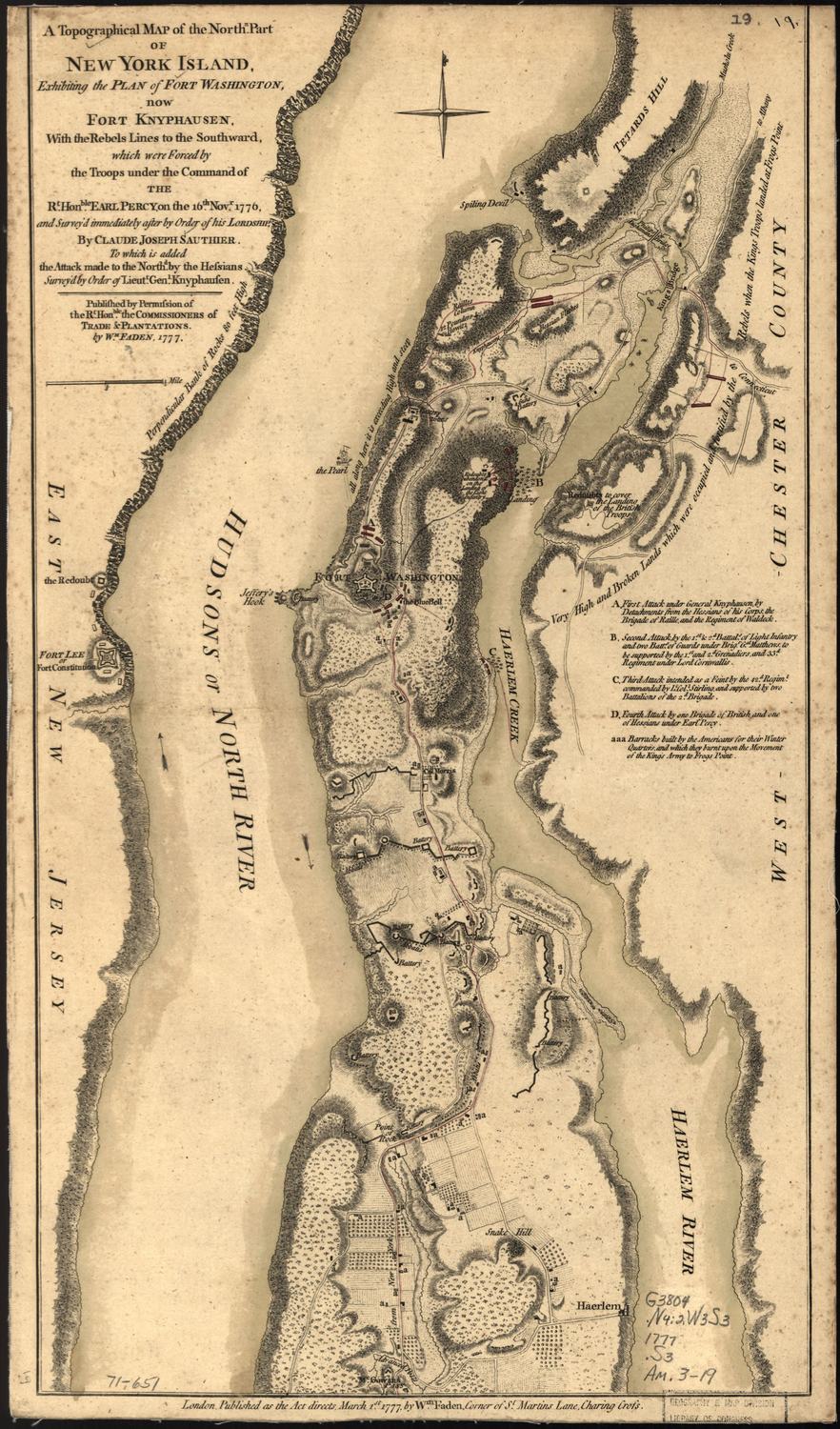
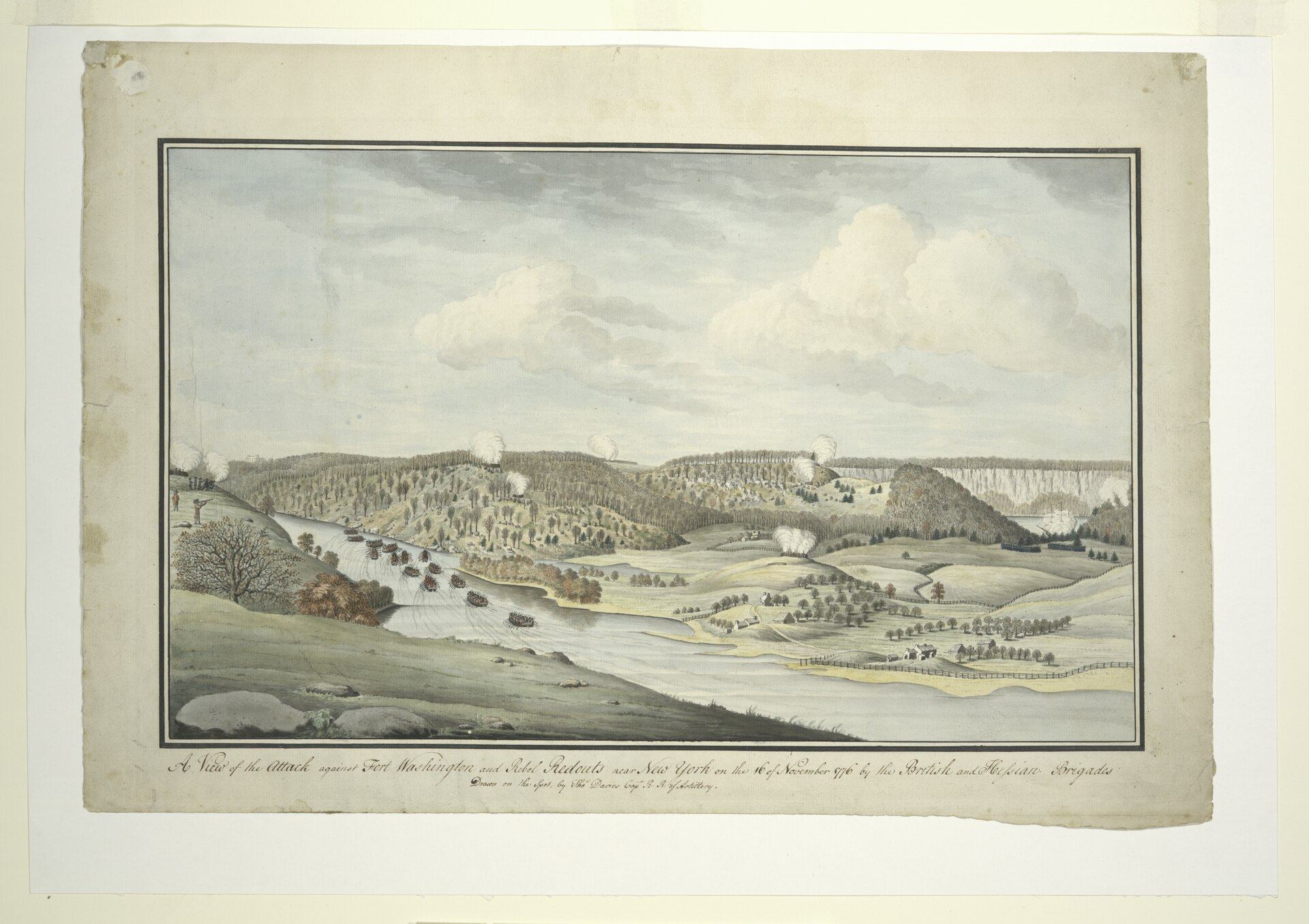
- The name and position of the fortress on the heights between the Hudson and the Harlem; the “Nort Hafen,” the North River, is the Hudson.
- What differs
- Reuber’s star has six points; the map shows five bastions. Davies paints a single frigate in the Hudson; Reuber’s two large ships of the line are symbolic. His view is mirrored, as if he were looking from the north.
- Copied?
- Probably not. The printed map appeared in London only in March 1777, when Reuber was already a prisoner. Much points to his own observation; that is not proof.
- Today
- Nothing is left of the fort. Streets and parks cover the narrow ridge, and next to it runs the George Washington Bridge.
This comparison exists for all twelve drawings.
How the diary reached its readers
- 1893
The Kassel magazine Hessenland prints the earliest known excerpts: Reuber’s account of the siege of Mainz. Reuber’s Europe came before his America. Copy (German)
- 1894
F. W. Junghans, “The American Campaign of the Hessians, from the Diary of Grenadier Johannes Reuber of Niedervellmar, 1776–1783,” in the Hessenland, in three installments (nos. 12 to 14). The same volume adds the campaign in Flanders and the piece “From the Year 1806.” Copies (German): America · Flanders · 1806
- 2006
Bruce E. Burgoyne, “Diary of a Hessian Grenadier of Colonel Rall’s Regiment”: a free English rendering of the years 1776 to 1783, as a typescript.
- n.d.
Herbert H. Freund, “Diary of a Hessian Soldier, Johannes Reuber”: a second English translation, at LancasterHistory in Pennsylvania, the town where Reuber was held prisoner in 1777.
- 2022
Werner Brandau, Im Dienst der britischen Krone (In the Service of the British Crown), Vellmarer Geschichtsbücher vol. 6, second edition.
- 2026
This edition: Brandau’s book, checked against the sources, with Reuber’s drawings, in German and English. English title: The Wrong Side of the Delaware.
Known in America
Museum of the American Revolution, Philadelphia
A life-size figure shows him as “one of 30 men from Niedervellmar.”
Visit the museumFriederike Baer, Hessians, 2022
Today’s standard work on the German soldiers in this war; awarded the prize of the Society of the Cincinnati in 2023. On her website she keeps a section of its own on Reuber.
Baer on Reuber’s voyage to SavannahSteven Bier, Facing Washington’s Crossing, 2025
The book on the Hessians at Trenton puts Reuber at its center, next to two officers.
Review in the Journal of the American RevolutionExhibit in New Jersey, 2026
Since April 2026 one of his ship drawings has been on view at the Cornelius Low House Museum in Piscataway.
Rutgers University newsWhat keeps being retold wrongly
Some claims travel from book to book without anyone checking them. For this edition we checked them against the sources. Four examples:
ToldWashington attacked Trenton with 15,000 men.
DocumentedHe crossed the Delaware with some 2,400 men.
ToldColonel Rall was drunk on Christmas night.
DocumentedResearch largely considers this a legend. Rall underestimated the enemy; that is enough.
ToldGeneral Custer descended from a Hessian soldier who stayed in America.
DocumentedA widespread family legend, not established.
ToldThe Battle of Long Island was on August 20, 1776.
DocumentedIt was on August 27, 1776.
He did not go alone
Other men from Niedervellmar and Obervellmar went to America with Reuber. Their names and dates, from HETRINA, the register of Hessian troops in the American War of Independence, are in the book.
Does your family descend from a Hessian soldier? Under “Sources and Ancestors” we show where you can look.
Sources and Ancestors