250 Years Ago
Reuber’s war is turning 250. Here, for each of the great days, is what happened and what Reuber himself wrote about it.
We begin with November 16, 1776: the storming of Fort Washington, the Americans’ last fortress on Manhattan. Forty days later Reuber is captured at Trenton.
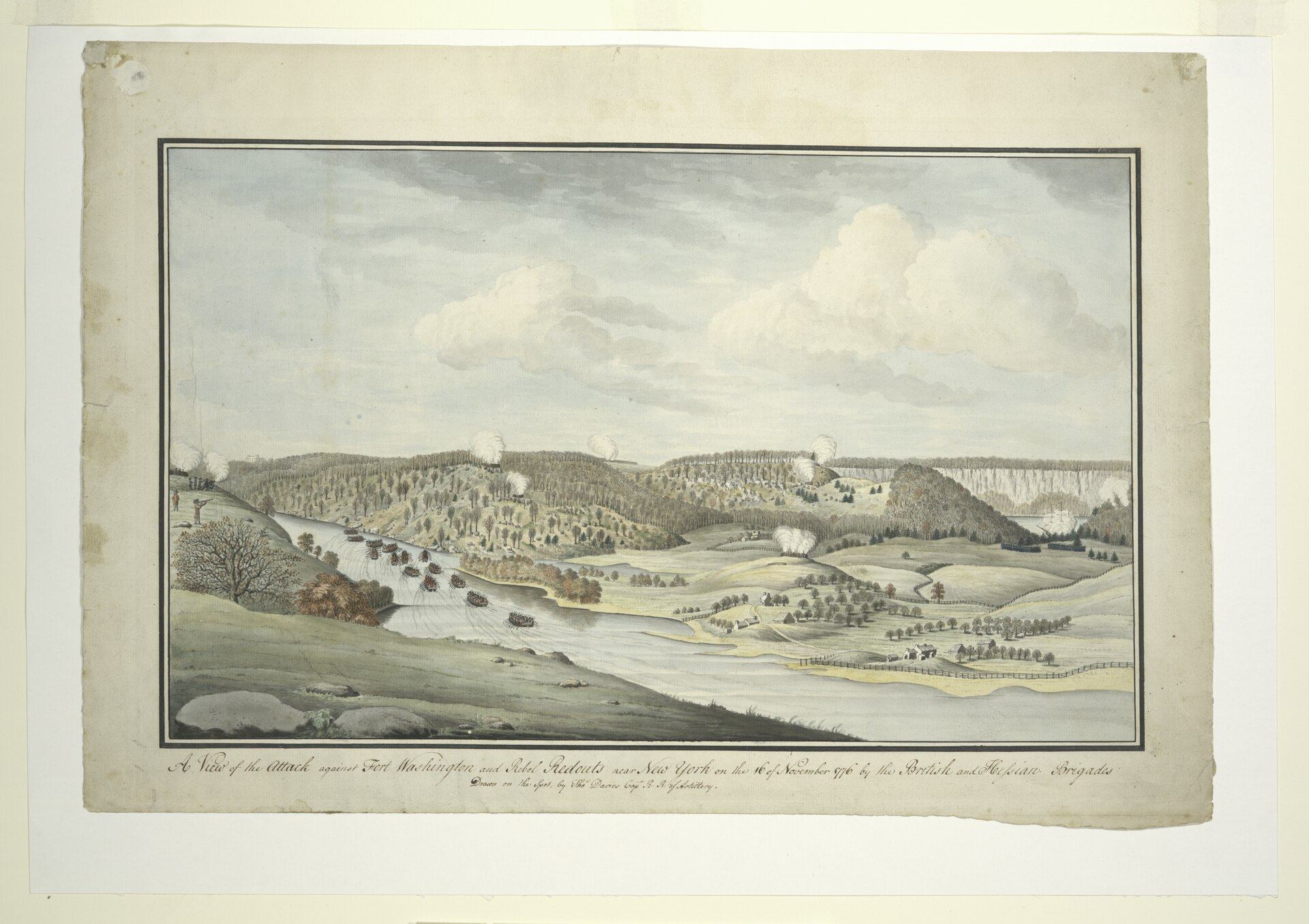
Thomas Davies, “A view of the attack against Fort Washington,” watercolor. New York Public Library. Public domain.
The Storming of Fort Washington
By the fall of 1776 the British had taken New York. Only in northern Manhattan did the Americans still hold a fortress, on the highest point of the island between the Hudson and the Harlem River: Fort Washington. On November 15 its commander, Colonel Robert Magaw, refused to surrender.
On the morning of November 16 some 8,000 British and Hessian troops attacked from three sides against about 3,000 defenders. From the north came the Hessians under General Wilhelm von Knyphausen. Rall’s grenadiers, Reuber among them, climbed the steep slope south of Spuyten Duyvil.
Soon the fortress was surrounded, by land and from the river. Magaw surrendered it to Knyphausen. 2,837 Americans went into captivity; many of them died in the following months in New York prisons and on prison ships. The British now called the fortress Fort Knyphausen.
Sources: Battle of Fort Washington (Wikipedia) · British Battles: Fort Washingtonarchive · American Battlefield Trust: Forts Washington and Leearchive · Maryland State Archives: “A Cursed Affair”archive · World History Encyclopediaarchive
“All that are my grenadiers, march forward!”
On the morning of November 17, 1776, all the regiments and corps assembled before daybreak, the Hessians on the right wing by the north harbor, the English on the left wing by the south harbor. Now that it was day, all the regiments marched forward—under the fire of the warships—up the hill and the rocky cliffs; one man fell down alive, another was shot dead; we had to pull ourselves up by the wild boxwood bushes; at last we did get up a little way, since we found trees and big stones; but there both sides went at each other hard; but because it would not give way, Colonel Rall then gave the command: All that are my grenadiers, march forward! All the drummers beat the march, the horn players blew. All at once everyone who still had life in him shouted with all his might: Hurrah; and straightaway everything was all mixed together, too; Americans and Hessians were as one; not another shot was fired, but everyone ran forward straight at the fortress.
Now when we came up, the Americans had a trench around the fortress. When we were in it, the word for us was: Halt. Then the Americans wanted to run out through our midst, toward the fortress; but then the word was: You are prisoners of war. The fortress was summoned at once by the Hessian General von Kniphausen. The rebels agreed to capitulate within two hours. When the two hours were up, the fortress Fort Washington was surrendered to the Hessian General Kniphausen with all its stores, etc.
Johannes Reuber, diary, in the wording of the book’s English edition. Source text: Junghans in the Hessenland, 1894, pp. 167–168, copy in the reading room (German).
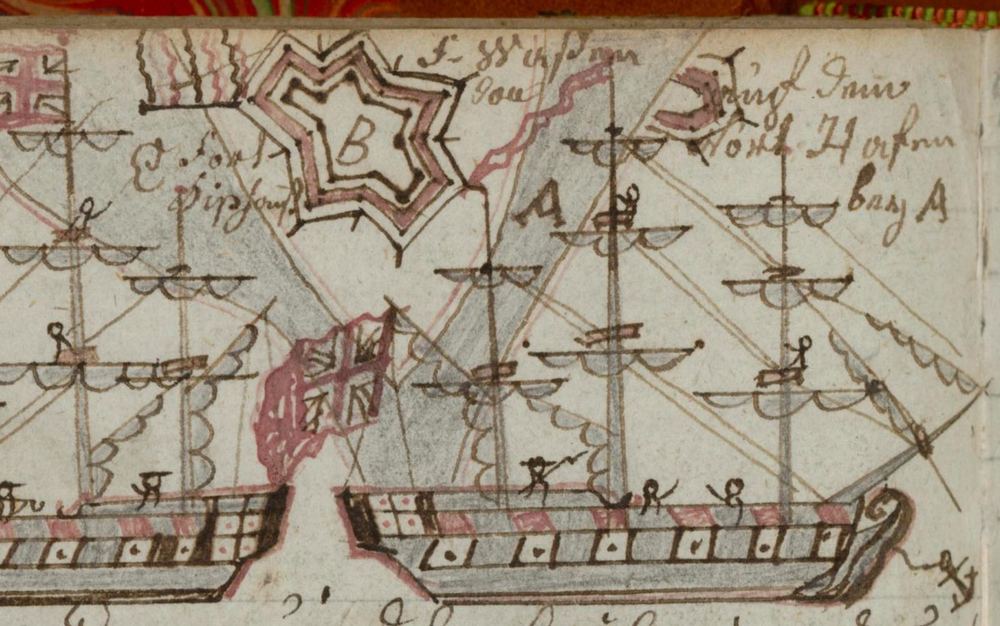
Reuber dates the storming to November 17; it was the 16th. His wording is left unchanged. Note on the companion pages, no. 69 (German).
Margaret Corbin
When Americans think of Fort Washington, they think of a woman. On the northern outwork, today’s Fort Tryon Park, Margaret Corbin of Pennsylvania stood with her husband John at a cannon. When he fell, she took over his gun until she herself was badly wounded.
In 1779 Congress granted her half a soldier’s pay for life. She is considered the first woman in America to receive a pension for military service. Her monument stands in the cemetery of the Military Academy at West Point.
The attackers on the northern outwork were Hessians. Whether Reuber stood where Corbin was firing, we do not know. All that is certain: that morning both fought on the north side of the fortress, on opposite sides.
Sources: DAR: Who was Margaret Cochran Corbin?archive · Margaret Corbin (Wikipedia) · Historical Society of Pennsylvaniaarchive · Marker in Fort Tryon Park (HMdb)archive
Bennett Park and Fort Tryon Park
Where the fortress stood is today’s Bennett Park on Fort Washington Avenue between 183rd and 185th Streets. Stones in the ground trace its walls. A tablet on the rock marks the highest natural point in Manhattan, 265 feet above sea level.
North of it, in Fort Tryon Park, a tablet honors Margaret Corbin, and the drive through the park bears her name. For years the Fort Tryon Park Trust has held a commemoration in the fall, with an encampment and reenactors in the dress of 1776.
Reuber’s drawing, the map of 1777, the watercolor of 1776, and today’s aerial photograph are shown side by side on the page Diary and Drawings.
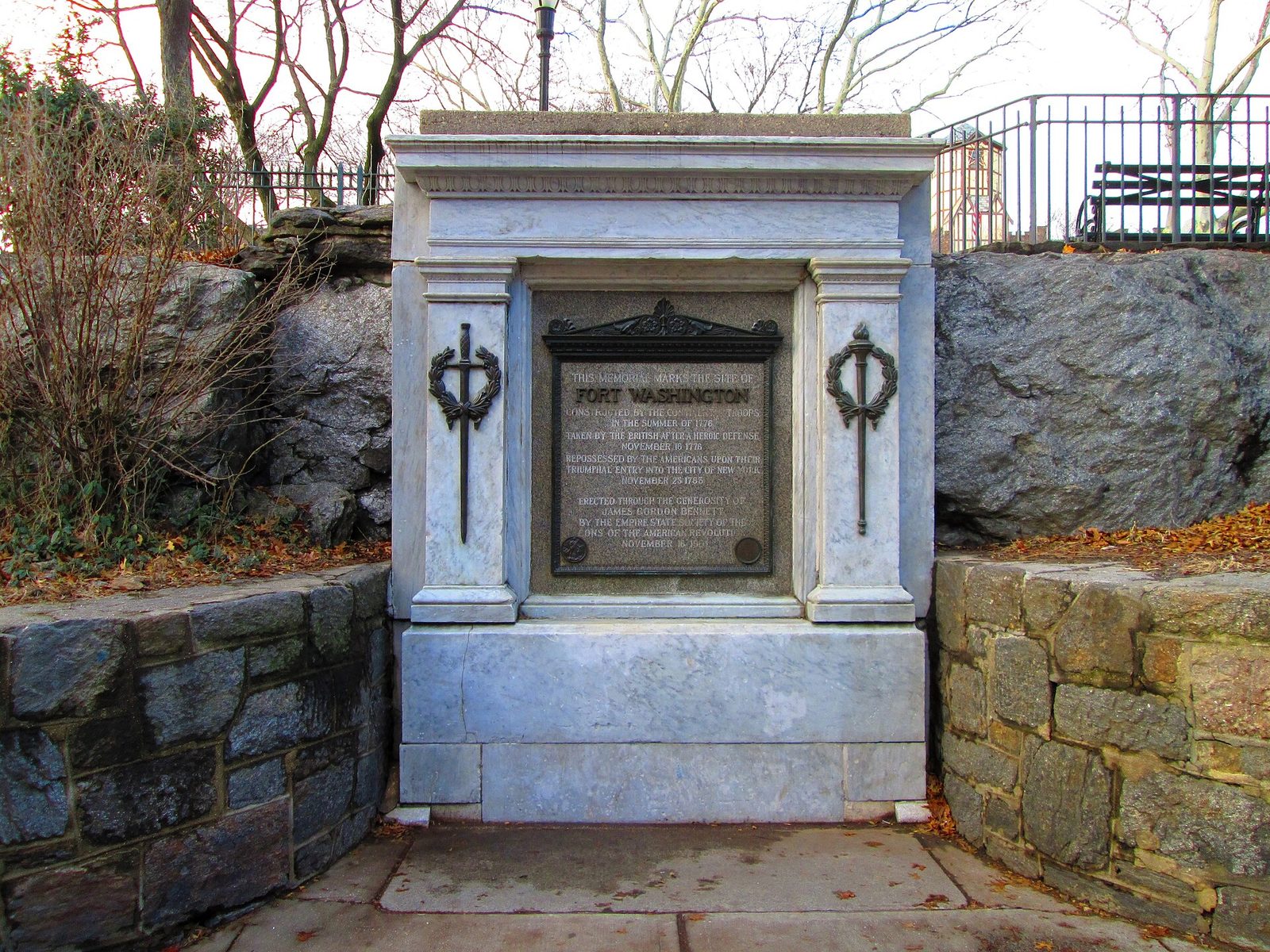

Sources: Fort Washington marker in Bennett Park (HMdb)archive · Highest point in Manhattan (HMdb)archive · Fort Tryon Park Trust: commemorationarchive
What came next
Washington had to watch the fall of the fortress from across the river, from Fort Lee in New Jersey. On November 20 British and Hessian troops crossed the Hudson. The Americans abandoned Fort Lee and retreated through New Jersey and across the Delaware.
In these weeks Thomas Paine wrote the sentence every American schoolchild knows: “These are the times that try men’s souls.”
Rall’s brigade followed and on December 14 took up winter quarters in Trenton. Forty days after Fort Washington, on the morning of December 26, Reuber was captured there.
Sources: The Liberty Trail: Fort Leearchive · American Battlefield Trust: Fort Lee, November 20, 1776archive · Companion pages, no. 70 · no. 71
Reuber’s war, 250 years on
- November 16, 1776Mon., Nov. 16, 2026
Storming of Fort Washington. Above on this page.
- November 20, 1776Fri., Nov. 20, 2026
British and Hessians cross the Hudson; the Americans abandon Fort Lee.
- December 14, 1776Mon., Dec. 14, 2026
Rall’s brigade takes up winter quarters in Trenton.
- December 25–26, 1776Fri./Sat., Dec. 25–26, 2026
Washington crosses the Delaware on Christmas night. In the morning Reuber is captured at Trenton.
- December 30, 1776Wed., Dec. 30, 2026
The Trenton prisoners are led through Philadelphia and on to Lancaster.
- 17772027
Captivity at Lancaster, march as far as Winchester, Virginia.
- September 17782028
Exchange of prisoners. At the end of the year Reuber sails to Savannah.
- 17802030
Before Charleston, South Carolina.
- October 17832033
Reuber’s ship anchors off Bremerlehe. After seven years he is home again.
Each of the great days will get its own article here. Reuber’s whole life is on the page His Life; the events for Trenton 250 are on In America.
Sources: Washington to the Pennsylvania Council of Safety, December 29, 1776, with note on the march through Philadelphia (Founders Online) · Companion pages, notes